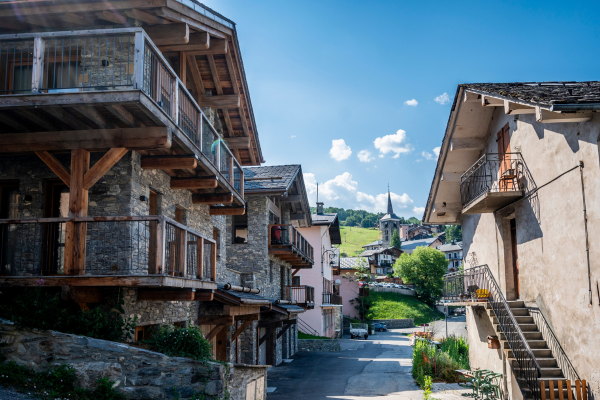
Property market trends in the Alps in 2026: the forecasts
Property market trends in the Alps in 2026
Property market trends in the Alps for 2026 confirm that the market remains highly attractive, but above all more selective. Following the sharp rises seen in the post-Covid years, the question is no longer simply whether prices will rise: it is essential to understand which properties, resorts and locations will best retain their value in the years to come.
Property forecasts for the Alps are now based on several indicators: altitude, scarcity of land, energy efficiency, tourist appeal and financing conditions.
Why should we be looking now at property trends in the Alps for 2026?
Anticipating market trends
Keeping track of property market trends enables you to anticipate demand. In ski resorts, the price per square metre remains high, but it is no longer enough on its own to gauge the value of a property. Views, access to the slopes, aspect, amenities, the condition of the block of flats and rental potential all play a direct role in this assessment.
Securing a purchase or sale transaction
Whether you are buying or selling, it is essential to understand how the property market in the area where your project is located is developing. Interest rates always affect borrowing capacity: in September 2026, average rates stood at around 3.5 per cent for a 20-year mortgage, according to several estate agents. A reliable estimate therefore enables you to better position a transaction.
Identify medium- and long-term opportunities
Property market forecasts for the Alps do not predict a uniform rise in prices. Rather, they help to identify properties likely to retain their property value: sought-after locations, architectural quality, recent renovation or potential for a change of use.
The Alpine property market: an overview ahead of 2026
The French Alps remain a major attraction
Data from the FNAIM confirms the strength of the market. As at 1 October 2025, the average price in municipalities with a ski resort stood at €4,003 per square metre, compared with 2,997€ per square metre across France. In the Northern Alps, it stood at 5,201€ per square metre. Prices had risen by 3.5 per cent over the previous six months.
Mixed market performance across the resorts
The property market is far from uniform. Major international resorts, family-friendly resorts and mountain villages cater to different demands. Trends must therefore be analysed on a resort-by-resort basis.
Key trends in the Alpine property market in 2026
Moving upmarket and searching for luxury properties
Buyers are looking for rare properties that are ready to move into: chalets, well-located apartments in resorts, properties with terraces, views, direct access to the slopes or high-end amenities. In the 71 main Alpine resorts surveyed by the FNAIM, the average price stood at 5,843€ per square metre in 2025.
A shift towards higher-end properties and a demand for luxury homes
Scarcity of land and supply under pressure
Land values underpin markets where town planning restricts development opportunities. This scarcity increases the appeal of sites that are already developed and well integrated into the local area. It is a key factor in property market forecasts for the Alps.
Growing interest in turnkey properties
Expectations are changing rapidly.
A renovated, furnished property that is ready to move into or let may be preferred to a cheaper property requiring extensive renovation work.
This trend particularly benefits properties in good locations with modern amenities.
The impact of environmental issues on the property market in the Alps
Energy efficiency and the renovation of older buildings
Energy performance is becoming a key indicator of value. From 2025, a property classified as ‘G’ can no longer be let under a residential tenancy agreement; properties classified as ‘F’ will be affected from 2028 and those classified as ‘E’ from 2034. In ski resorts, the FNAIM estimates that nearly two-thirds of properties could eventually be affected if they are not renovated.
For owners, the Energy Performance Certificate (EPC) must therefore be factored into any future valuation. For buyers, an energy-inefficient property can represent an opportunity if it offers manageable renovation potential.
New developments and the adaptation of the mountain housing stock
The new-build programme addresses some of these challenges by providing more energy-efficient buildings that are suited to modern lifestyles. Off-plan sales may appeal to buyers looking for a new home that requires less work in the short term.
Alpine resorts that are holding their own
High-altitude resorts remain a firm favourite
Altitude remains a key indicator of trends in the property market. According to the FNAIM, in the Alps, prices have risen 1.5 times faster above 1,500 metres than below that altitude over the last five years.
The search for more reliable snow conditions is contributing to this trend.
The resurgence of authentic mountain villages
The villages also have their own attractions: traditional architecture, unspoilt surroundings, local life and access to ski resorts. They meet the expectations of buyers looking for a quieter second home and a year-round holiday destination.
Property price trends for 2026: what can we expect?
Stability, an uptrend or a correction?
Property prices in the Alps in 2026 are expected to remain heavily dependent on the quality of the properties and the resorts. A widespread correction is not the only possible scenario: the most plausible forecast is that of a multi-tiered market. Scarce properties may remain in high demand, whilst energy-inefficient or poorly located properties will come under greater pressure.
Price differences between new and older properties
New-build properties offer energy efficiency and amenities that often justify a higher price. Older properties, however, retain an advantage when they are in an exceptional location and have well-managed renovation potential. Any comparison must take into account the purchase price, renovation costs, service charges and rental potential.
| Indicator | Reference figure |
|---|---|
| Average price in resort towns | 4 003 €/m² |
| French average | 2 997 €/m² |
| Northern Alps | 5 201 €/m² |
| Major Alpine resorts | 5 843 €/m² |
| Change over the last 6 months in 2025 | +3,5 % |
| Val d’Isère | 14 696 €/m² |
| Courchevel | 13 637 €/m² |
| Méribel | 11 444 €/m² |
These figures are mainly taken from the FNAIM study published in December 2025.
Investing in property in the Alps in 2026: opportunities and strategies
Buy to build value in the medium term
An investment strategy may focus on creating value rather than merely on immediate profitability. Buying a well-located property, improving its performance and then holding onto it for several years can be a sensible approach in a market where supply remains limited.
Wealth-building investment vs rental yield
Rental yield must be assessed in light of seasonality, service charges, personal occupancy and rental demand. The regulations governing furnished holiday accommodation are also changing, making it essential to analyse the local regulatory framework before undertaking any project.
The importance of local expertise in the face of property trends in 2026
Understanding Alpine micro-markets
Property market trends in the Alps in 2026 are no substitute for an on-the-ground analysis. Two properties of the same size may have very different values depending on the floor they are on, their aspect, the view, their distance from the slopes, whether they are part of a block of flats, or their rental potential.
Knowledge of the resorts
Local expertise enables you to understand price variations per square metre, development projects, sought-after blocks of flats and buyers’ expectations. This is essential if you want your project to come to fruition without any hassle.
Adjusting the buying or selling strategy
In a more demanding market, the asking price must reflect local market conditions. Forecasts are intended to inform a decision to buy or sell, not to replace it.
Market trends in Saint-Martin-de-Belleville
Saint-Martin-de-Belleville perfectly illustrates the specific characteristics of the Alpine property market in 2026. Various available sources currently put average prices at around 7,000€ to 7,500€ per square metre, with significant variations depending on the type of property, its location and its standard of finish.
The village benefits from its Savoyard character and its access to the Trois Vallées. The current property market there favours well-located, renovated properties that are suitable for letting. Whether it is a chalet or a resort flat, location remains a key factor.
| Property Type | Estimated Average Price per m² in 2026 | Indicative Price Range |
|---|---|---|
| Apartment | Approximately €6,600 to €6,800/m² | From €3,500/m² to over €13,000/m², depending on location and features |
| Chalet / Mountain House | Approximately €8,500 to €9,000/m² | Up to over €17,000/m² for exceptional properties |
| High-end Property with Premium Features | Varies depending on location | Price determined through a personalised valuation |
Tailor-made support from the experts at Collection Chalet
Collection Chalet supports owners and buyers with their plans to buy, sell, let and invest in Saint-Martin-de-Belleville and neighbouring resorts.
This local valuation takes into account the condition of the property, its co-ownership arrangements, its rental potential and the specific characteristics of the market.
The current property market ultimately shows that the mountains remain an attractive destination, but one that is becoming more demanding. Property forecasts must be interpreted in the context of altitude, scarcity, build quality, energy efficiency and new uses. Property prices in the Alps in 2026 will therefore not be determined by a single factor: value will depend primarily on the actual quality of the property and the suitability of its location.
Charly. G